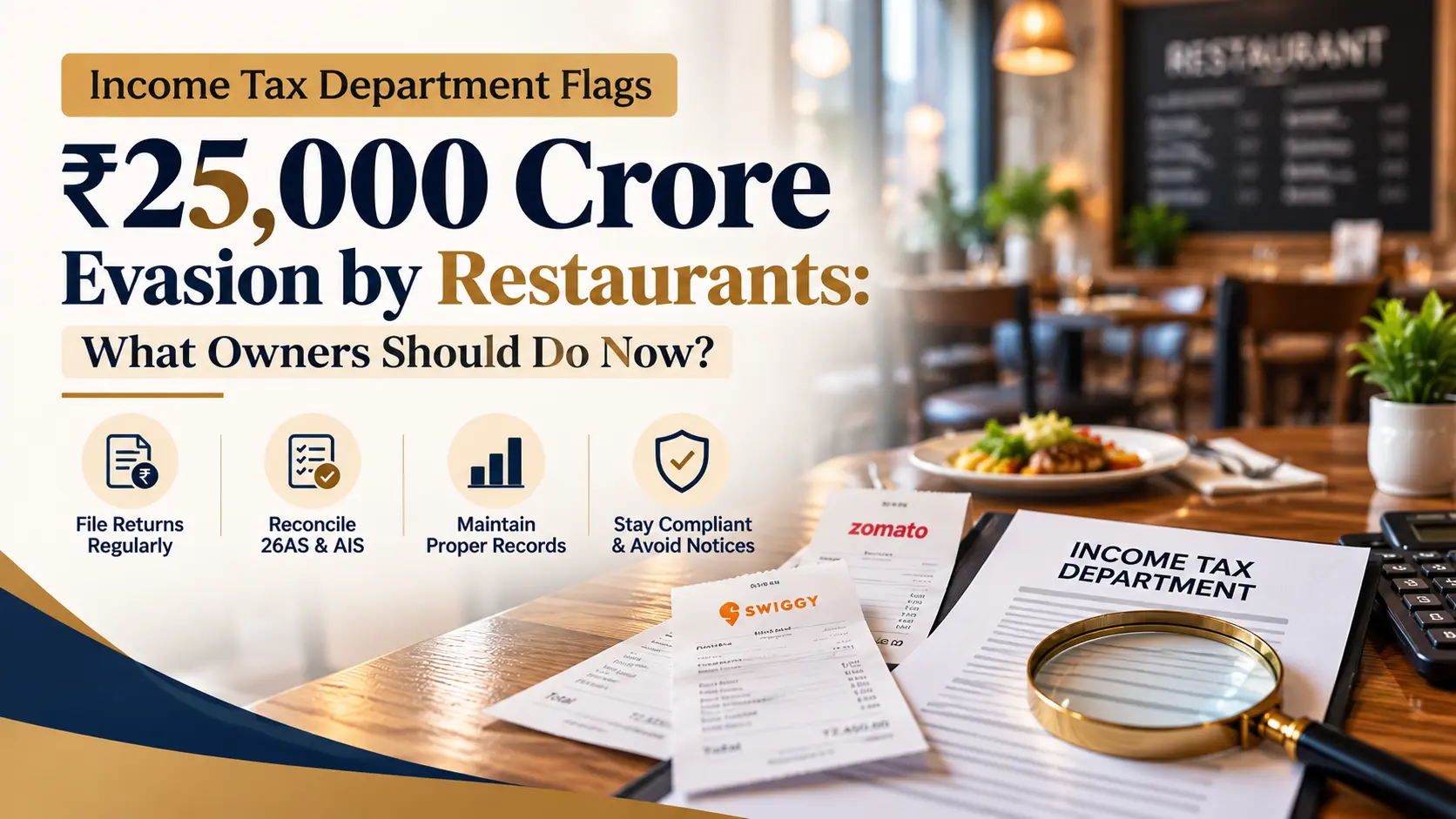
Income Tax Department Flags ₹25,000 Crore Evasion by Restaurants: What Owners Should Do Now
A recent Times of India report says the Income Tax Department has detected large-scale tax evasion by restaurants, which it estimates at around ₹25,000 crore. For anyone running a restaurant, café or cloud kitchen, this is a clear signal that data-driven scrutiny of the food industry has arrived.
As a CA firm in Mumbai working with food businesses, here is our plain-language summary of what the department is seeing and what you should do next.
What platforms report
TDS at 0.1% of the bill amount on delivery orders, visible to the department against your name.
What the department infers
Dine-in typically earns 3–4 times delivery revenue, so total income can be reasonably estimated.
- ₹25,000 crEstimated tax evasion by restaurants
- ₹7,500 crEvasion estimated from Swiggy and Zomato data alone
- 8,000Restaurants with TDS deducted but no income tax return filed
- 65%Rise in the number of restaurants on delivery platforms
1. What the Data Shows
Based only on information from Swiggy and Zomato, the department pegs the evasion at about ₹7,500 crore. Around 8,000 restaurants had TDS deducted against their names by these platforms but never filed income tax returns.
| Metric | 2021-22 | 2024-25 |
|---|---|---|
| Sales through food delivery platforms | ₹1,450 crore | ₹2,700 crore |
- Over the four years from 2021-22, the government collected close to ₹75 crore in TDS from these platforms.
- The number of restaurants on these platforms rose by 65% over the same period.
2. Why the Department Is Confident in Its Estimates
Food delivery platforms deduct TDS at 0.1% of the bill amount under Section 194-O. This TDS does not apply to dine-in customers, who typically generate three to four times the revenue a restaurant earns from delivery.
Delivery income
- TDS deducted by Swiggy, Zomato and other platforms.
- Reported against the restaurant’s PAN and visible to the department.
Dine-in income
- No platform TDS, so not directly reported.
- Typically 3–4 times delivery revenue, giving the department a reliable benchmark.
Why it matters: If delivery income is known, total income can be reasonably estimated. Where reported income looks far too low compared to that benchmark, the restaurant becomes a likely target for scrutiny.
3. How the Department Is Acting
- Nudge campaign: taxpayers whose data shows under-reporting are prompted to correct their returns.
- The department is now reportedly identifying restaurants across major cities, most with income of ₹2–5 crore.
- Earlier exercises also found income being suppressed through cash handling and payments routed via accounts of waiters and workers.
4. What Restaurant Owners Should Do
- File income tax returns every year. TDS deducted in your name is visible to the department, so non-filing stands out immediately. Our income tax return filing services can help you stay on track.
- Reconcile Form 26AS and AIS with your books and correct any mismatches.
- Record all receipts, including dine-in, cash and UPI, in your billing system. Well-kept books through our accounting services in Mumbai make this easier.
- Keep business collections out of staff and personal accounts. This is a known red flag.
- Respond to notices and nudge emails promptly instead of ignoring them. Our tax advisory services can help you draft the right response.
- Review past years. If income was under-reported, consider filing a revised or updated return before the department contacts you.
- Maintain proper books and GST records, as the department can cross-check income tax data against GST filings. See our GST compliance services.
5. Conclusion
Data matching has made under-reporting far easier to detect. Voluntary compliance today is much cheaper than penalties, interest and prolonged scrutiny later.
If you run a food business, a timely review of your filings can save you significant trouble. Keep track of return and TDS due dates on our Compliance Calendar FY 2026-27.
How Anam Shaikh & Associates Can Help
At Anam Shaikh & Associates, we help restaurants and food businesses with income tax, GST and TDS compliance end to end, including:
- Income tax return filing, including revised and updated returns
- TDS, Form 26AS and AIS reconciliation through our direct tax services
- Replies to income tax notices and nudge emails
- Income tax audit for restaurants above the audit limit
- Outsourced accounting and billing system reviews
- GST audit and income tax–GST reconciliation
Get a compliance health check for your restaurant
Contact Anam Shaikh & Associates, Chartered Accountants, Mumbai for income tax filing, GST, TDS reconciliation and notice handling.