What is the Difference Between Accounting and Bookkeeping?
04/28/2026
Introduction:
When we hear the term “accounting” at first, it might not be clear what it is. That’s because there are many different types of accounting out there. Accounting services can help you track your income and expenses, manage taxes, prepare for audits, and more. In this article, find out what the difference between accounting and bookkeeping is and how they both contribute to your business success.
What Is Accounting?
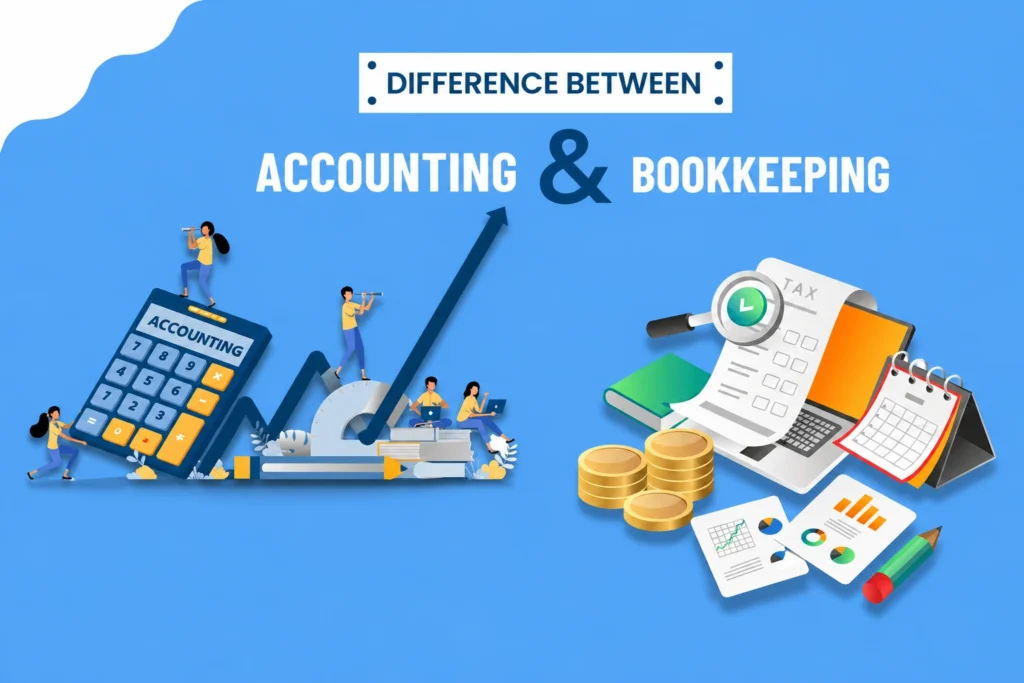
Accounting is a system of gathering, analyzing, and reporting information about economic activities to provide useful information for decision making and management. Bookkeeping is the process of recording financial transactions such as sales, purchases, receipts and payments.
The Difference Between Bookkeeping and Accounting
In accounting, the terms “assets” and “liabilities” refer to the different sides of a firm’s balance sheet. Assets are things that have value and can be used to generate cash flow. Liabilities, on the other hand, are things owed by firms that must be paid back with money. In bookkeeping, assets may also be referred to as “books.”
Person Responsible for Maintaining Books of Accounts
Managing Director,
Whole-Time Director, in charge of finance
Chief Financial Officer (CFO)
Any other person of a company authorized by the Board.
Accounting Standards
An accounting standard is a collection of rules, norms, and procedures that govern the firm’s systematic bookkeeping and other accounting operations throughout the year. The Accounting Standards Board (ASB) is a body within the Institute of Chartered Accountants of India (ICAI) that comprises of members from government departments, academics, other professional groups, and so on. The National Financial Reporting Authority (NFRA) recommends these accounting standard formulations to the Ministry of Corporate Affairs (MCA)
Which One is Right for You?
Bookkeeping is a more common term and is defined as the process of recording financial transactions in order to make sense of the company’s operation. In contrast, accounting is the process of preparing an annual or business registration period report for a set of customers, government agencies, banks, shareholders, etc. One might be best for your specific needs and the other could work well for you if you have a lot of transactions taking place daily.
Conclusion
One of the most common ways a business pays for goods and services is through an accounting firm. An accounting firm will take care of the financial side of a business. They’ll prepare payroll and tax returns, manage bank accounts, and more. A bookkeeper’s responsibilities are to track all transactions that happen with the company registration and make sure they’re documented properly.
Contact Anam Shaikh & Associates Consultancy For Your Accounting Services
In general, accounting is the process of tracking, recording, and reporting financial information about a company or entity. This can be done for any business entity which is usually a local or national legal person or body. Bookkeeping is the process of managing records of transactions taking place in a business to ensure that all the data are properly recorded and maintained. The services offered to businesses in India by Anam Shaikh & Associates consultants include accounting, bookkeeping and tax services.
Assisting business owners with their financial records of the company through regular reporting and audits is one aspect of our services. Other services include preparing financial statements, audit/tax compliance procedures, or risk management as well as managing capital projects, small business loans etc. We also provide back-office support for specific projects that involves multiple teams like HR, payroll and procurement and so on.
Key Differences
Required Education
Bookkeepers often need a high school diploma or associate degree, with additional certifications being beneficial and act as an added advantage.
Accountants typically hold a bachelor’s degree in accounting or finance, with many pursuing advanced certifications like the CA, MBA, etc.
Skills Needed
Bookkeepers indeed need strong organizational skills, attention to minute details, and proficiency with accounting software and a lot of knowledge of accounting and its rules. Accountants, on the other hand, need critical thinking about the process and system and how things are flowing in terms of finance, problem-solving skills and solution oriented appraoch, and an in-depth understanding of financial regulations applicability.
The Shifting Landscapes of Bookkeeping and Accounting
In recent years, the lines between bookkeeping and accounting have started to blur. Technology and automation are changing the way both professions operate nowadays.
Merging Bookkeeping and Accounting Functions
With advancements in software, many accounting and bookkeeping tasks are now highly automated. For example, cloud-based accounting platforms like QuickBooks, Xero, etc, can perform tasks that once required separate bookkeeping and accounting efforts. This merging of functions means smaller businesses may only need one professional to handle both roles at the same time.
Bookkeeping May Become Obsolete
As automation may continues to improve, basic bookkeeping tasks may eventually become redundant and obsolete. Some experts even predict that artificial intelligence (AI) and machine learning will eliminate much of the need for human bookkeepers in the near future.
Extending the Services
Both bookkeepers and accountants are increasingly offering additional services beyond traditional functions in order the survive in the existing markets. Bookkeepers may now offer payroll services or more detailed financial reporting, while accountants may assist with business strategy and consulting and sometimes even assist in filling services.
Advent of Smartphones
The rise of smartphones has also had a huge and significant impact on the industry. Mobile Apps or Mobile Applications now allow business owners to track their expenses quickly, scan receipts, and even generate invoices, reducing the daily workload for both bookkeepers and accountants. The Process got more automated with the advent of smartphones
More Efficient Services
Both professions i.e. Bookkeepers and Accountants get benefit from modern technologies, enabling faster, more accurate, and cost-effective services provision. This efficiency allows both bookkeepers and accountants to focus on providing higher-value services to the business owners.
Similarities Between Accounting and Bookkeeping
While the roles are different, bookkeeping and accounting share many similarities. Both rely on a strong understanding of financial principles, organizational skills, and attention to detail. Moreover, both professionals work toward the same goal: ensuring a business’s financial health and compliance with regulations.
Can I Do My Own Bookkeeping?
For small businesses with basic financial needs, it’s possible to manage your own bookkeeping. Many business owners use user-friendly software to track transactions, generate reports, and stay on top of their financial responsibilities by themselves. However, as your business grows, it may be wise to hire a professional bookkeeper to avoid errors and ensure compliance at the fullest in order to avoid the late Fees and penalties.
Can I Do My Own Accounting?
No, It is never advised to do the same on own. However, basic accounting tasks like budgeting and financial planning can be done on your own, more complex tasks like tax preparation, audits, and financial analysis require expertise. If you’re unsure about your ability to manage these tasks, it’s best to consult with a qualified accountant or Chartered Accountant for the same.
Looking for Top Indirect Tax Services in Mumbai?
If you’re based in Mumbai and looking for expert advice on indirect tax services, fill out the form below to find the best options tailored to your needs by Anam Shaikh & Associates.
Conclusion
In summary, while bookkeeping and accounting are interconnected and goes hand in hand, they serve different purposes in managing the finances of a businesses and have individual roles. We the above blog, we hope that we are clearly able to provide you with the difference between Bookkeeping vs. Accounting. Bookkeepers focus on recording transactions, while accountants interpret that data and provide strategic advice to the business. As technology continues to evolve, both fields are changing, with automation playing a larger role in daily operations. Regardless of these shifts, having a clear understanding of both bookkeeping and accounting is essential for any business looking to thrive.
Bookkeeping focuses on recording financial transactions, while accounting involves analyzing and interpreting financial data for decision-making. This is the main difference in Bookkeeping vs. Accounting.
We wish to consistently build value for our clients by delivering a motivated and committed team of professionals working hand in hand to maintain the highest standards of integrity and confidentiality in fulfilling client-specific needs.