TCS on GST For E-commerce Operators : Applicability and Rates
Tax Deducted at Source (TDS) and Tax Collected at Source (TCS) are very similar concepts, however TCS has several important distinctions. Tax Deducted at Source (TDS) refers to the amount of tax withheld from a payment made by a contract’s recipient. On October 1, 2018, with a few exceptions, all online merchants will be required to collect TCS. In this piece, we’ll break down how TCS relates to GST.
Take, as an illustration: When a vendor sells its wares or provides its services over an e-commerce platform and the operator collects payment from the vendor, this transaction is known as tax collection service (TCS).
What is TCS on GST?
By “TCS on GST,” we mean the GST that is deducted from the payment made to a vendor who makes a supply through an online marketplace on the operator’s behalf. TCS is determined by dividing net taxable supplies by TCS. Specifically, TCS under GST is addressed under Section 52 of the CGST Act.
Who is responsible for collecting TCS on GST?
Many thanks to the owners, managers, and operators of the various e-commerce platforms on which TCS relies. For TCS to apply, operators must collect client payments on behalf of vendors or suppliers. In other words, when remitting funds to sellers, e-commerce platforms must deduct TCS before transferring the remaining funds.
Certain e-commerce platform services are exempt from the TCS rules, as listed below:
Venues like hotels and clubs (unregistered vendors)
Transportation for people, via radio cab, motor cab, or motorbike
Repairs of plumbing, drywall, and woodwork, as well as general cleaning (unregistered suppliers)
For instance, An individual business, Raj Stores, sells garments on the online marketplace Flipkart.
Because of its status as an e-commerce provider, Flipkart must withhold TCS from any consideration it collects on behalf of XYZ before transferring the funds to the latter.
What is the TCS applicability rate?
After a 1% TCS reduction, online marketplaces will pay the dealers and traders who supply their goods and services.
In Notification No. 52/2018 issued under the CGST Act and Notification No. 02/2018 issued under the IGST Act, the CBIC made the rate official.
This means that for supplies made within the same state, TCS of 1% will be collected (0.5% under CGST and 0.5% under SGST). The IGST Act mandates that the TCS rates for interstate transactions be set at 1%.
Who is responsible for TCS?
The TCS payment is paid to the government by the e-commerce operator through the GSTR-8 Return. Could I get a refund for TCS Deducted?
To the extent that TCS is deducted by the E-Commerce Operator, the full amount should be credited to registered sellers through the E-Commerce Portal.
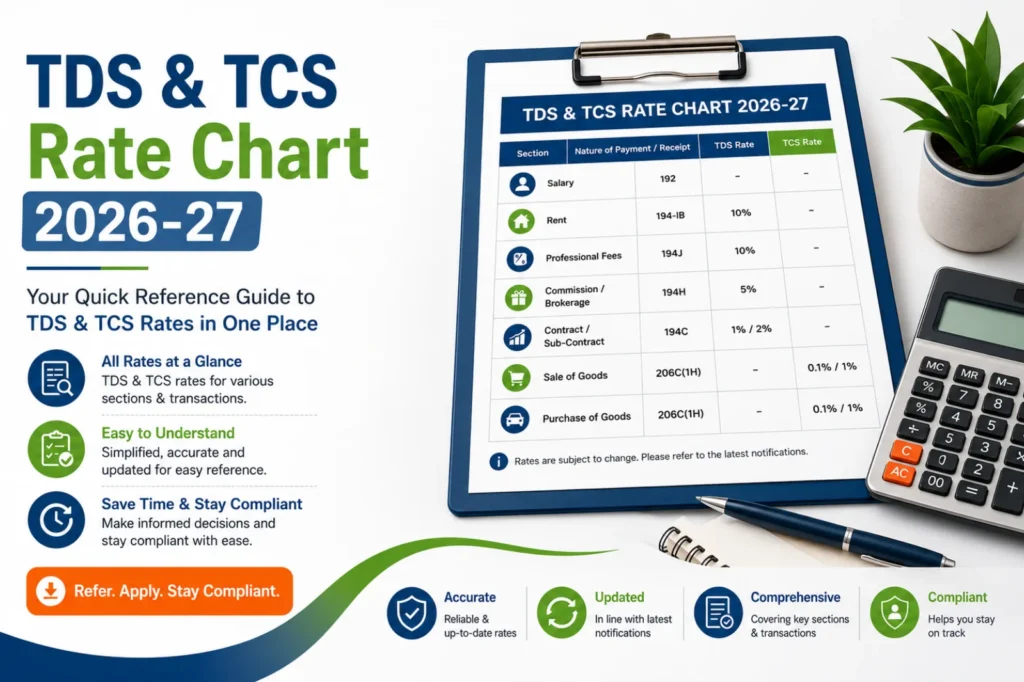
What goods are covered under TCS?
Types of Goods
Tax rates
Product sales to a single customer totaling more than Rs. 50 million
0.1%
Timber woods under a forest lease or any other mode
2.5%
Tendu leaves
5%
Forest produces other than tendu leaves & timber
2.5%
Liquor of alcoholic nature, made for human consumption
1%
Minerals like lignite, coal & iron ore
1%
Purchase of motor vehicle exceeding Rs.10L
1%
Parking lot, Toll Plaza & Mining & Quarrying
2%
How do I obtain the TCS Credit?
Registered Sellers of Electronic Commerce Portals can claim a complete refund of any TCS deducted from their sales by filing a “TDS and TCS Credit Receivable return” through the GST Portal.
Credit Receivable Return Submission Methodology at TCS:
Visit the Portal and sign in.
Go to TDS and TCS Credit Received under Services > Returns.
Pick a fiscal year and a reporting period.
Select “Online Preparation.”
Click the “TCS Credit” button to access your account.
Take the credit, or don’t.
To file your tax return, use either DSC or EVC.
Credit will be applied to your Cash Ledgers once the return is filed, and you may then use that money to pay any taxes owed.
Effect of GST under TCS on E-Commerce Operators
Online marketplaces like Amazon, Flipkart, and Snapdeal had to revamp their online payment system and accounting practises in order to comply with TCS on GST.
They need to get GST registration in every state they do business in. To put these regulations into practice in regular companies, ERP systems must be well connected.
However, in order to conduct business on such marketplaces, E-tailers or sellers must first register for GST. In addition, until these suppliers complete their reports and collect the additional taxes, their working capital will be frozen if they provide through an e-commerce operator.
Benefits of TDS and TCS on GST
In many ways, GST tax deductions and credits are advantageous. In an effort to better regulate tax evasion, the government implemented TDS and TCS in GST. Tax deducted at source (TDS) and tax collected at source (TCS) under GST are addressed in Sections 51 and 52 of the CGST Act.
There would be an immediate update in the electronic books of the deductee or supplier once the deductor files their returns under the TDS system. This tax payment will be credited to the deductee’s electronic cash ledger where it can be used to pay other taxes whenever the deductee sees fit.
The use of TDS has proven to be a highly effective method of bringing previously unorganized sectors into compliance with tax regulations and reducing the likelihood of fraud.
TCS under GST also monitors online vendors, records financial dealings, and ensures that taxes are paid on schedule.
TCS on GST : Registration requirements provisions
There is no threshold restriction for GST registration, thus all e-commerce businesses that are obligated to collect TCS must register. With a few exceptions, anyone selling a product through an e-commerce platform’s online marketplace must also be registered for GST.
Please note the following before registering:
Every online business that must collect TCS must also register for GST.
Except for suppliers that have been notified under Section 9 (5) of the CGST Act, anyone who makes a supply through an e-commerce operator.
Transporting people via radio-taxi and motorcycle OR Providing housing in hotels, guest homes, for residential or lodging purposes (unregistered providers) OR Providing house-keeping services like plumbing and carpentry are all examples of supplies included in Section 9 (5). (unregistered suppliers).
In all three instances, the online retailer is responsible for collecting GST and remitting it to the appropriate authorities. Therefore, if a supplier’s annual revenue doesn’t exceed Rs.20 lakh (or Rs.40 lakh), they don’t need to register as required by law as long as they supply the services specified in 9 (5).
In addition, if a service provider’s annual gross sales are less than Rs.20 lakh or Rs.40 lakh, they do not need to register as a business (assuming they do not make inter-state supplies).
Online retailers are required to register just like any other business selling products to consumers.
If an online retailer has a physical presence in more than one state, it must register for GST in each of those states.
TCS deposit deadline
In the month of supply, the final day of the month is the due date for TCS deposits. After the end of the month of supply, it will be deposited to the government’s credit within 10 days.
Here are the methods by which the tax is disbursed:
IGST and CGST will be the responsibility of the federal government.
Taxes on goods and services charged by the federal government and owed to individual states.
TCS on GST provisions impact
Before October 1, 2018, the effective date of implementing TCS regulations, online merchants must register with each state’s GST agency. Therefore, well-integrated ERP systems are required to smoothly execute these provisions in operational procedures.
In addition, until a vendor files their taxes and claims any overpayment, their working capital will be frozen if they sell through an e-commerce operator. Because of this, it’s possible that fewer small and medium-sized enterprises will use the platform to market and sell their wares and services.
The government claims that if taxes are taken out of every purchase, tax evasion will be drastically cut down.
E-commerce sellers using GSTR-8 data in GSTR-2A
All suppliers will have access to the data operators submit in GSTR 8 via GSTR 2A. If you miss the GSTR-8 deadline, don’t worry; you can access the materials in GSTR 2A. Please be aware that the GSTR-2B return will not include information about these credits.
Instead, suppliers’ electronic cash ledgers will record the tax payments they’ve received. After confirming their supplies are listed accurately in GSTR 2A, suppliers can submit a claim for the credit.
GSTR 8 returns cannot be changed after they have been submitted. Both the operator and the supplier will be informed of any discrepancies found while matching and reconciling supply data and GSTR 2A.
If the error is not fixed by the provider by the deadline, the supplier’s liability will increase by the tax amount. The difference, plus any applicable interest, is due from the vendor.
Why you should shift to Anam Shaikh & Associates?
Learn Why Anam Shaikh & Associates Is The Best GST Software Available:
A commitment to data integrity, confidentiality, and availability is made.
Your purchase will be reconciled mechanically by GSTR 2B.
Eliminating manual processes for filing GSTR-1, GSTR-3B, GSTR-9, and GSTR-9C.
It is imperative that you immediately inform your suppliers.
Intelligently identifies noncompliant vendors and puts a hold on all or part of their payments.
As a result, you can avoid losing resources and face.
Appropriate for use by corporations of all sizes.
ITC (Input Tax Credit) claims can be maximized with the help of early reconciliation.
Reconcile your accounts quickly and easily by downloading many reports at once.
Supports seamless integration with leading enterprise resource planning and accounting packages.
Completely guarantees the integrity of information stored in the cloud and on the internet.
We wish to consistently build value for our clients by delivering a motivated and committed team of professionals working hand in hand to maintain the highest standards of integrity and confidentiality in fulfilling client-specific needs.