CBDT’s Six Scenarios That Could Put Your Tax Return Under the Microscope
Helping Startups Manage Finance, Compliance & Growth

05/21/2026
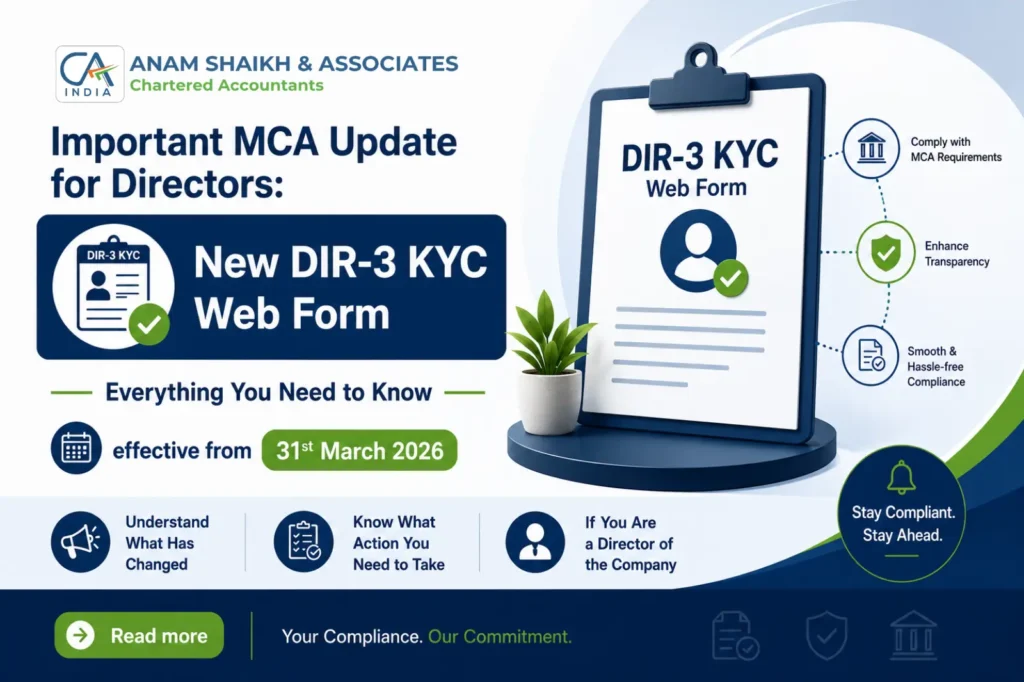
The Ministry of Corporate Affairs (MCA) has introduced significant changes to the DIR-3 KYC compliance framework through Notification G.S.R. 943(E) dated 31st December, 2025. These changes are effective from 31st March 2026 and aim to simplify the KYC compliance process for all directors holding a Director Identification Number (DIN) in India.
If you are a director of a company, it is important that you understand what has changed, what it means for you, and what action you need to take. In this blog, we have explained the new DIR-3 KYC Web form rules in simple language.
DIR-3 KYC is a mandatory compliance requirement under the Companies Act, 2013 for every individual who holds a Director Identification Number (DIN). It is basically a Know Your Customer (KYC) process that the MCA uses to keep director details up to date in its records.
Until now, directors had to file their KYC every year — either through the e-form DIR-3-KYC or the web service DIR-3-KYC-WEB. Failure to file resulted in the DIN getting deactivated, which would prevent a director from continuing to serve on any company board.
With the new amendment, the MCA has now merged both forms into one single form called Form DIR-3 KYC Web and changed the filing frequency from annual to once every three years.
Here is a summary of the major changes that every director must be aware of:
The amendment replaces the old Rule 12A with a new version under the Companies (Appointment and Qualification of Directors) Rules, 2014. Here is what the new Rule 12A says:
Every individual who holds a DIN as on 31st March of a financial year must file their KYC details through Form DIR-3 KYC Web on or before 30th June of the immediately following every third consecutive financial year. This means that if you have filed your KYC for FY 2025-26, your next filing will only be due by June 2028.
If there is any change in your personal mobile number, email ID, or residential address, you must file Form DIR-3 KYC Web within 30 days of that change along with the prescribed fee. Importantly, this update filing does not affect or reset your regular three-year compliance cycle.
Important Note : The 30-day update requirement is triggered by any change in your mobile number, email ID, or residential address — not just at the time of your triennial filing. Missing this 30-day window can result in non-compliance.
The MCA has provided three illustrations to help directors understand when their next filing will be due. Here is a simplified version:
If your DIN was allotted during Financial Year 2025-26, your first DIR-3 KYC Web filing will be due between April 2029 to June 2029. After that, you will need to file once every three financial years.
If you already filed DIR-3 KYC (e-form or web) for FY 2025-26 — meaning your DIN was allotted on or before 31st March 2025 — you do not need to file for FY 2026-27 or FY 2027-28. Your next filing will be due between April 2028 to June 2028, provided your KYC details have not changed.
Suppose your DIN was allotted on 1st January 2026 (FY 2025-26) and in FY 2027-28 you change your mobile number and file DIR-3 KYC Web to update it. This update does not change your three-year compliance cycle. Your next KYC compliance filing will still remain due from April 2029 to June 2029, as the cycle is counted from the year of DIN allotment.
The new Form DIR-3 KYC Web is a web-based form that can be filed on the MCA portal. It requires the following information from the director:
Important Note :Sections 448 and 449 of the Companies Act, 2013 provide for punishment for false statements and false evidence. Both the director and the certifying professional are legally liable for incorrect filings.
With the new rules coming into effect from 31st March 2026, here is what every director should do immediately:
This amendment is a step in the right direction by the MCA. The move from annual KYC to a triennial filing cycle significantly reduces the compliance burden on directors especially those serving on multiple boards.
Instead of worrying about filing KYC every year, directors can now focus on their core responsibilities and plan their compliance well in advance. The consolidation of two forms into one also makes the process simpler and less confusing.
At the same time, the 30-day update requirement ensures that MCA records remain accurate. This is a balanced approach — less repetitive compliance, but quick disclosure when something actually changes.
At Anam Shaikh & Associates, we help directors and companies stay compliant with all MCA requirements — on time, every time. For personalised guidance on your DIN KYC compliance, contact us today.
☎ Call / WhatsApp: 076201 44726
✉ Email: ca.anamshaikh@gmail.com
🌐 Website: www.anamca.com
We wish to consistently build value for our clients by delivering a motivated and committed team of professionals working hand in hand to maintain the highest standards of integrity and confidentiality in fulfilling client-specific needs.
This will close in 0 seconds
WhatsApp us