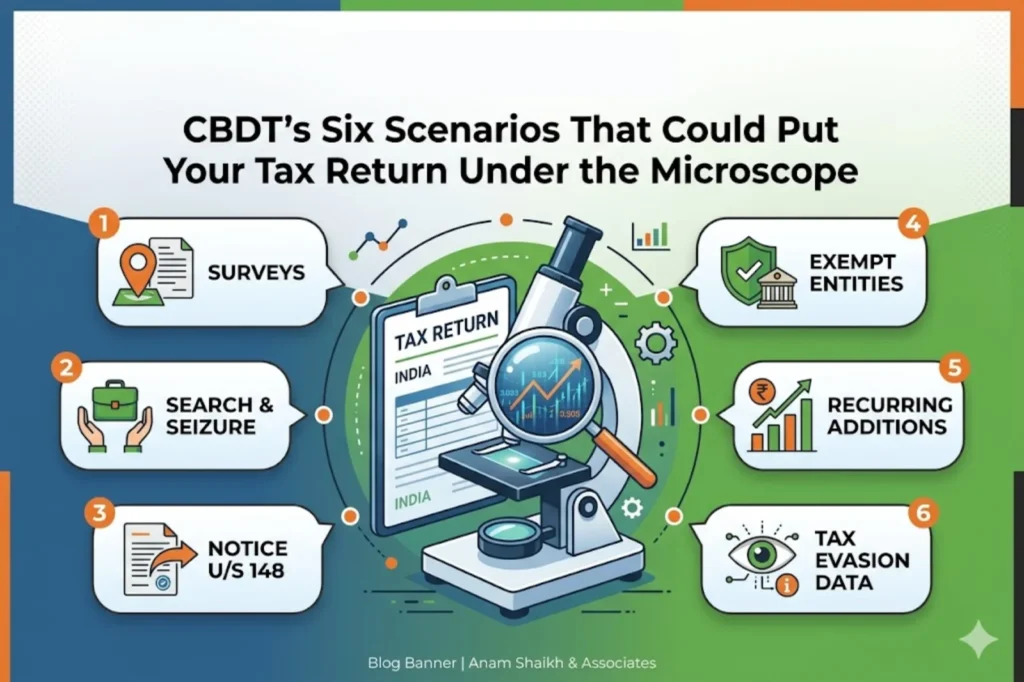
CBDT’s Six Scenarios That Could Put Your Tax Return Under the Microscope
Helping Startups Manage Finance, Compliance & Growth

A Practical Comparison for Salaried Employees and Business Owners
06/04/2026
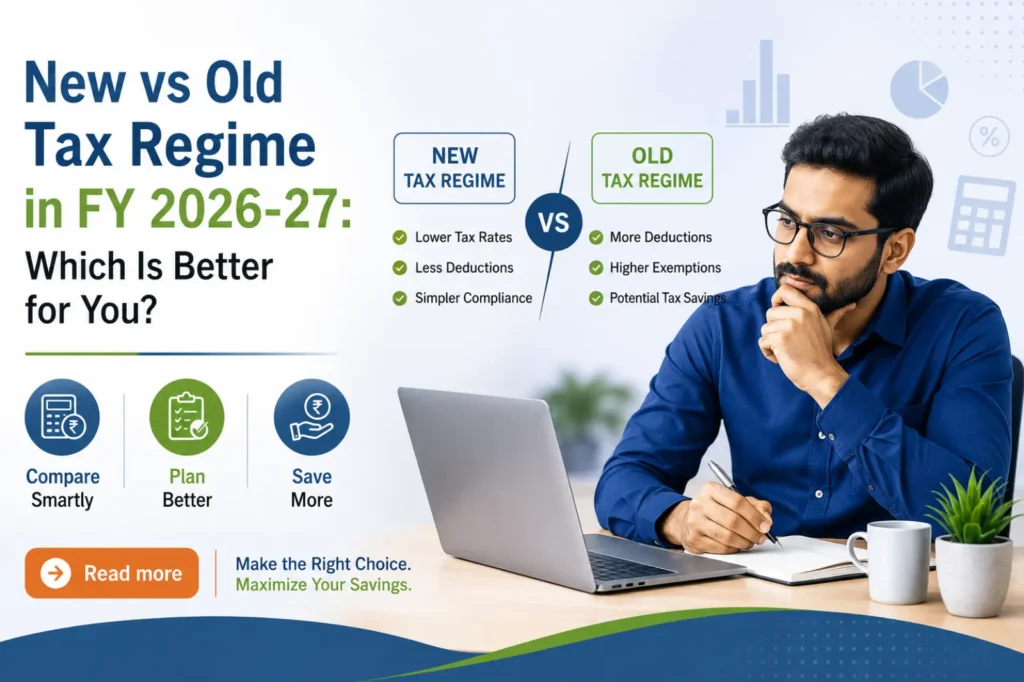
If there’s one question our clients ask us every year without fail, it’s this: ‘Should I go with the New Tax Regime or stick with the Old one?’
The honest answer? It depends. But with the right framework, the decision becomes a lot clearer. Let’s break it down.
The New Tax Regime was introduced in FY 2020-21 and has been the default regime since FY 2023-24. For FY 2026-27, if you do nothing — you’re automatically under the New Regime.
The Old Regime, with its higher tax slabs but rich deductions, still exists — but you have to actively opt for it.
Bookkeeping is the practice of recording a business’s financial transactions. We will understand in details about the Importance of bookkeeping in business through this Blog:
Income Range | Tax Rate |
Up to Rs. 4,00,000 | Nil |
Rs. 4,00,001 – Rs. 8,00,000 | 5% |
Rs. 8,00,001 – Rs. 12,00,000 | 10% |
Rs. 12,00,001 – Rs. 16,00,000 | 15% |
Rs. 16,00,001 – Rs. 20,00,000 | 20% |
Rs. 20,00,001 – Rs. 24,00,000 | 25% |
Above Rs. 24,00,000 | 30% |
Note: Under the New Regime, income up to Rs. 12 lakh is effectively tax-free due to the Rs. 60,000 rebate under Section 87A.
Income Range | Tax Rate |
Up to Rs. 2,50,000 | Nil |
Rs. 2,50,001 – Rs. 5,00,000 | 5% |
Rs. 5,00,001 – Rs. 10,00,000 | 20% |
Above Rs. 10,00,000 | 30% |
The New Regime offers lower slabs but strips away most deductions. The Old Regime has higher slabs but lets you claim a long list of deductions that can significantly reduce your taxable income.
Deductions Available ONLY in the Old Regime
Deductions Available in BOTH Regimes
If you have business income, you can switch regimes — but only once. After that, you’re locked in until you stop having business income. So choose carefully.
For most startup founders with significant investments in PPF, ELSS, or home loans, the Old Regime still makes more sense. But if you’re early-stage with minimal tax-saving investments, the New Regime’s simplicity is a genuine advantage.
Don’t pick a regime based on what your colleague chose. Run the numbers for your specific situation or better yet, let us do it for you. A 15-minute conversation with our team can save you thousands of rupees.
Ready to simplify your taxes and compliance? Talk to us.
📞 Call us: +91 76201 44726
💬 WhatsApp: wa.me/917620144726
🌐 Website: anamca.com
We wish to consistently build value for our clients by delivering a motivated and committed team of professionals working hand in hand to maintain the highest standards of integrity and confidentiality in fulfilling client-specific needs.
This will close in 0 seconds
WhatsApp us